Giving Compass' Take:
- Hannah Kowszun gives insights into how funders can engage in giving with few or no restrictions to better serve their grantees.
- How can you shift your giving away from restrictions? What kind of support most benefits the organizations you want to support?
- Read about the various benefits of unrestricted funding.
What is Giving Compass?
We connect donors to learning resources and ways to support community-led solutions. Learn more about us.
The relationship between a funder (or philanthropist) and a frontline charity should be one of mutual gain—both working towards social impact. The frontline charity is more likely to know what needs to be done to solve global problems and the funder facilitates this through their support, this is trust-based philanthropy in action.
But if you’re used to giving with restrictions, how can you move towards a more unrestricted model?
Due diligence
It all starts with having clear criteria for who you want to fund and why. Doing more work upfront, means less work later.
The kind of things you will want to understand about prospective charities are:
- Strategic focus
- Impact measurement
- Learning and improvement
- Financial health
- Leadership
It’s ok to ask questions. Your aim is to build a good understanding of the charity, what drives them, and how they operate. So that when you do fund them, you can genuinely say that you trust them to spend that money wisely.
Funding on a spectrum
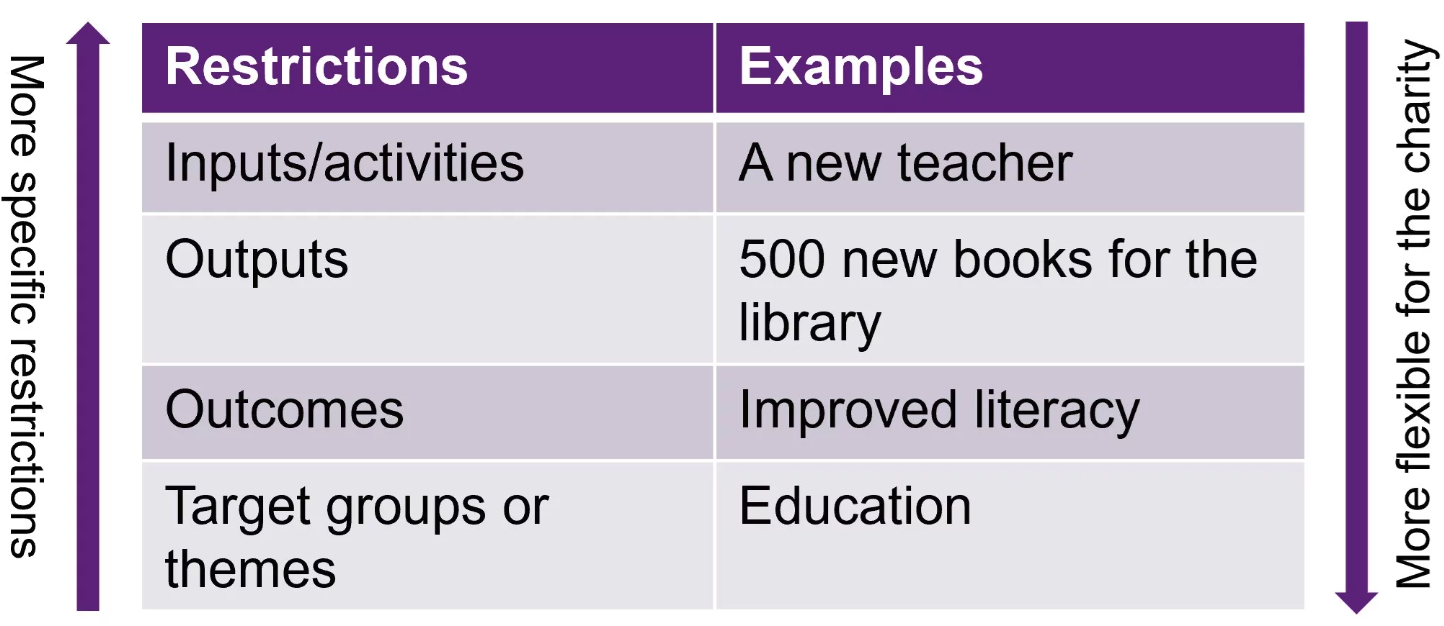
The levels of restriction you put on funding can be considered along a spectrum: from inputs, to outputs, to outcomes and finally to impact.
If your organisation isn’t quite ready to give fully unrestricted funding, consider where along this spectrum you would feel more comfortable.
For example:
Reporting
Funding without restrictions can reduce your administrative burden. You don’t need long reports with lots of questions. Instead, you can ask three simple questions:
- What have you done over the last year (or other length of time)? Make sure to ask about internal activity as well as external, as organisational health and investment can be just as important as delivery.
- Why? This represents a learning approach to impact – what is actually needed by users, what is working well or less well etc.
- What was your impact?
Trust on both sides
There are complicated power dynamics between frontline charities and those who fund them. It can be easier to surrender to a funder’s requests than to deliver what might actually be needed on the ground.
Read the full article about funding with few or no restrictions by Hannah Kowszun at NPC.