What is Giving Compass?
We connect donors to learning resources and ways to support community-led solutions. Learn more about us.
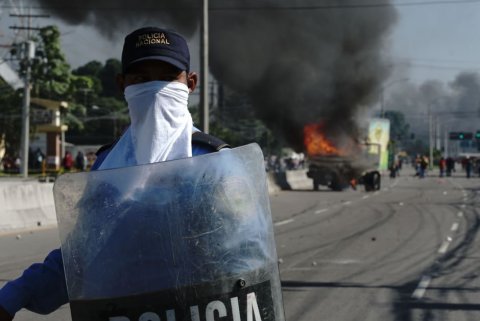
For several days in late November and early December, the sound of banging pots and pans from protests mixed with gunfire in the streets of Tegucigalpa, Honduras' capital.
Burning tires choked the air, and in one part of the city, an infant was hospitalized for smoke inhalation. In another neighborhood, a 12 year-old boy was shot by military police while coming home from playing soccer and is still recovering from his wounds.
"This country is a mess," says Kevin Rivera, a 22 year-old biology student at Universidad Nacional Autonoma de Honduras, whose campus is nestled in the eastern part of Tegucigalpa. He's seen the recent political demonstrations — which have claimed the lives of 14 people so far and resulted in more than 800 arrests — devolve into chaos. One man, who was detained in the clashes, tried to escape the back of a police motorcycle with his hands tied and was dragged along the ground, according to Rivera.
This has been the scene from a country in crisis ever since a disputed presidential election on Nov. 26. Incumbent Juan Orlando Hernandez, seeking a controversial second term, had been falling behind popular television personality Salvador Nasralla by five percentage points in preliminary results. But hours after polls closed, election officials stopped delivering the vote totals due to an alleged computer glitch. When the tally was reinstated, Hernandez suddenly had the lead. Nasralla’s Opposition Alliance disputed the results, as international groups — including the Organization of American States and the European Union — urged transparency.
On Sunday night, the country’s Supreme Electoral Tribunal (TSE) finally declared Hernandez the winner by 1.53 percentage points. But Nasralla said he plans to make his case to the OAS and U.S. State Department in Washington, as he continues to challenge the legitimacy of the election, urging his supporters to do the same.
This could only be the beginning.
"We get used to seeing dead people"
Meanwhile, in the streets of the capital and elsewhere, citizens are marching not just for Nasralla, but for what they see as a hopelessly fraudulent system that has been failing them for generations. According to The World Bank, more than 66 percent of Hondurans live in poverty, and one out of 5 people live on less than $1.90 per day. Decades of military coups, foreign intervention and drug cartel killings have devastated the population. In 2017, the World Economic Forum listed Honduras as the ninth most violent country, with 60 homicides per 100,000 people.
"We get used to seeing dead people on TV and in the streets. We know we have a corrupt and narco government," says Rivera. "We don't forget that you can go to a public hospital and there are no chairs or beds or even real aspirin: They serve you flour pellets instead. The last time the government built a new school was eight or more years ago."
David Ashby, founder of the Christian nonprofit organization Helping Honduras Kids, runs a children’s home in La Ceiba and a free private school for 225 Honduran students living in poverty, and has witnessed how the political turmoil can affect those trying to help.
"The closed roads from the protests makes it difficult to obtain food, gas and medicines which are scarce," he says. "When the roads are open, the traffic is terrible and dangerous, because everyone is trying to get supplies at the same time. Families with no economic resources suffer, and many don't vote or understand the political situation."
With Hernandez now declared the Honduran president under a process that is still being questioned, there is the fear of more violence in the weeks and months ahead. Already, a population that has endured political upheaval and economic hardship for many years has been put through the ringer once again.
They have banged on their pots and pans in the night to be heard. Now they need helping hands more than ever.
What You Can Do
Give to aid groups who directly assist Honduras. The crowdfunding community Global Giving lists 15 active Honduras-focused projects, many of which provide relief for children and families who lack basic necessities. If protests continue to disrupt the nation, those projects will be vital.
Stay informed. This is a story that hasn’t generated too many front-page headlines in the U.S., as Americans tend to be distracted at this time of year or focused on pressing domestic matters. But the New York Times, NPR and NACLA (a nonprofit news organization that covers Latin America and the Caribbean) all have done excellent work at keeping tabs on a volatile situation that shifts by the day. Read up, give well.
_____
Original contribution by Gabe Guarente, Content Manager at Giving Compass